


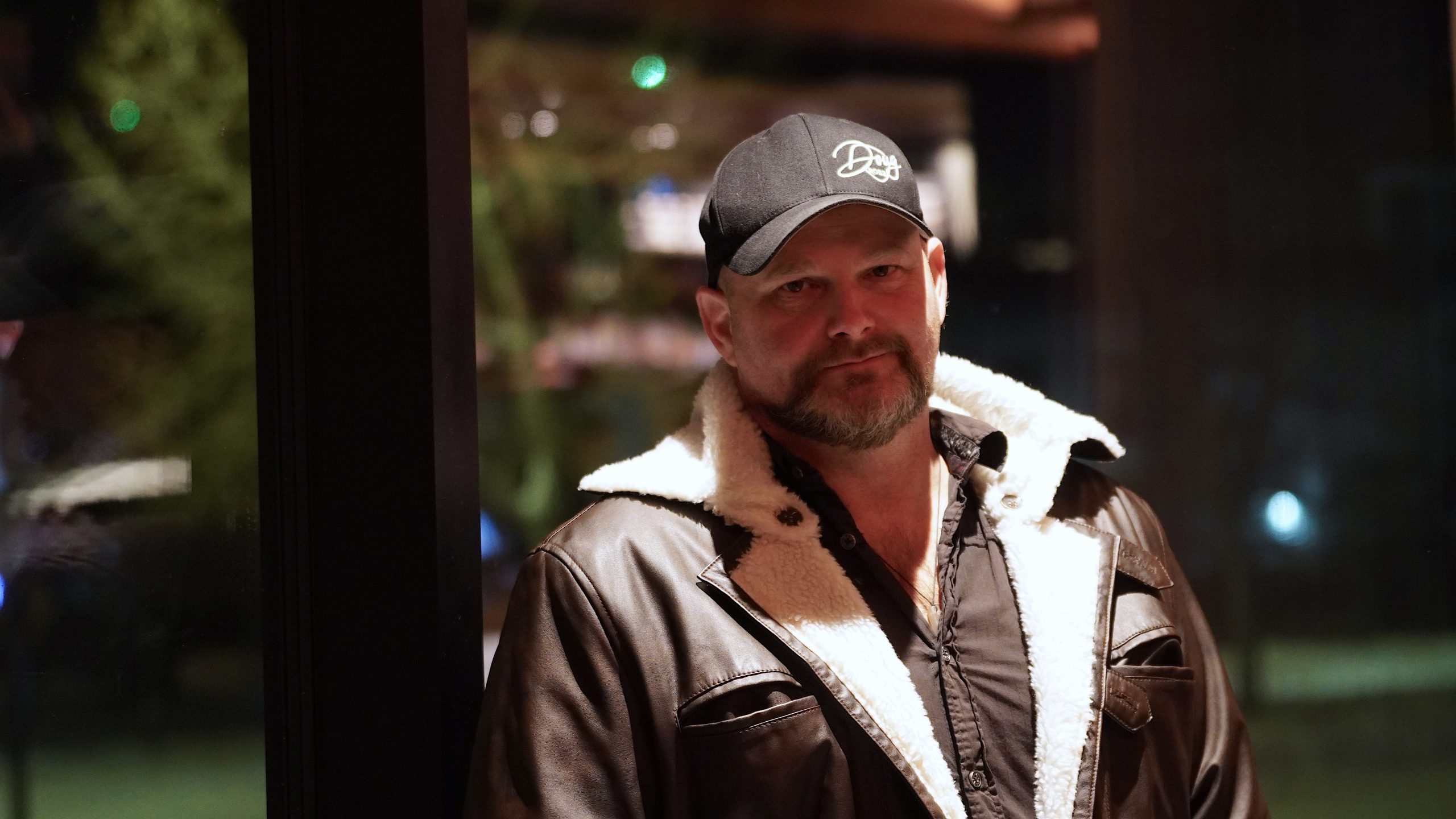
DOUG ROBB
By Jonathan Widran
There are moments when the life a person has carefully constructed no longer fits the person they’ve become. From the outside, everything may appear solid, even admirable: a respectable career, meaningful responsibilities, a practical existence maintained through discipline and sacrifice. Yet underneath the routines and expectations, something restless, deeper, a burgeoning creativity keeps pulsing forward, refusing to stay quiet
For Doug Robb, that pull never went away. It simply waited for the right moment to reclaim him.
Today, the veteran Canadian singer-songwriter behind Karma Klash occupies a radically different space than the one he spent much of adulthood trying to navigate. The shift did not arrive through overnight success, industry calculation, or some carefully engineered reinvention. It emerged slowly through accumulated experience — grief, fatherhood, sacrifice, frustration, resilience, and eventually the courage to abandon security in pursuit of something more truthful.
Karma Klash is not merely a rock project revived after years away from the spotlight. It feels more like the convergence of everything Doug has endured and discovered along the way. The band’s explosive energy carries the sweep of classic melodic arena rock, but beneath the muscular guitars and soaring hooks lies something deeper: the voice of an artist who spent years balancing obligation against creativity, stability against instinct, and practicality against the growing need to reclaim himself.
“I’m finally doing what I’m supposed to be doing,” Doug says. “That sounds simple, but it took me a long time to understand it. For years I convinced myself responsibility always had to come first — that passion was something you squeezed into whatever space remained. Eventually you realize that if you ignore the thing that gives you purpose long enough, it changes you. You stop recognizing yourself.”
As his tastes evolved, he gravitated toward artists capable of balancing power with vulnerability: Bryan Adams, Journey, Heart, Sammy Hagar, Huey Lewis, Chris Cornell and Ann Wilson. Their voices sounded larger than life while still carrying unmistakable humanity. “I always loved singers who could combine strength and vulnerability at the same time,” he says. “Not just technical ability. Anybody can hit notes. What matters is whether people believe you.”
Outside of music, Doug has also become deeply influenced by the mythic storytelling and moral philosophy of Star Wars, whose themes of inner conflict, redemption, destiny and perseverance resonated with him from an early age. He connected less with the spectacle than the underlying human questions woven throughout the saga — the tension between fear and hope, isolation and connection, darkness and personal responsibility. Those ideas quietly shaped the way he began viewing his own creative path. Much like the characters he admired, Doug increasingly came to see growth not as a straight line toward success, but as a difficult journey requiring failure, sacrifice, self-awareness and ultimately the courage to reclaim one’s identity.
Music, however, was only one possible future. Baseball became another. Doug excelled as a center fielder, eventually reaching AAA with the London Majors and drawing legitimate attention from the New York Yankees organization. For a time, professional sports appeared to be a very real path forward. Then everything shifted quickly. An injury during training camp abruptly derailed that trajectory.
Around the same period, Doug lost his father — a devastating blow that permanently reshaped his understanding of perseverance, mortality, and perspective. Born with hemophilia, his father lived with constant physical limitations that would have broken many people psychologically. Yet Doug remembers him not as fragile but fiercely determined. Even simple activities demanded adaptation, grit and creativity. “He couldn’t throw a baseball normally because of his shoulder,” Doug says. “So he’d catch with one hand, switch the glove over, and throw with the other. He wouldn’t let life tell him what he couldn’t do. That mentality stayed with me forever. A huge part of who I became came from watching him refuse to quit.”
Years later, those experiences would find their way into one of Karma Klash’s most heartfelt songs, “Lift,” a track that has become central to Doug’s evolving artistic identity. Significantly, the song appears in two distinct forms across his upcoming companion EP releases — one acoustic and introspective, the other fueled by the full-throttle melodic rock energy of Karma Klash itself. Together, the projects reveal the full scope of Doug’s artistry. One leans into stripped-down reflection and raw honesty; the other channels soaring hooks, massive guitars and the cinematic rush of classic arena rock. Rather than separating those instincts, Doug embraces both equally, allowing tenderness and intensity to coexist naturally within the same creative vision.
Listeners often interpret “Lift” as a romantic song, but Doug wrote it as a tribute to his father and the gratitude he still carries for the example he set. “When my dad passed away, I realized how much his attitude shaped me,” he explains. “He dealt with pain every day of his life and still kept pushing forward. ‘Lift’ came from wanting to honour somebody who taught strength without ever preaching it.”
That openness became central to Doug’s songwriting approach. Rather than filling songs with hyper-specific autobiography, he prefers creating space for listeners to project their own experiences into the material. That instinct explains why many Karma Klash songs feel expansive rather than narrowly autobiographical. Even when Doug draws from personal hardship, he intentionally leaves room for interpretation. A song rooted in grief may resonate as a love song for someone else. Lyrics born from struggle may feel empowering to another listener entirely.
That layered perspective became especially important during his years performing acoustic shows. While the electric Karma Klash material delivers explosive choruses and full-band catharsis, Doug also spent years standing alone with only his guitar and voice in coffeehouses, markets, resorts, seniors centers, homeless shelters and intimate community spaces. Those performances fundamentally changed his understanding of connection.
“When you’re acoustic, there’s nowhere to hide,” he says. “You can see people reacting in real time. You’re making eye contact. You feel whether they believe you or not. Sometimes somebody’s smiling. Sometimes they’re crying. Sometimes they tell you afterward that a song reminded them of somebody they lost. That changed me as a writer.”
Performing in shelters and outreach programs especially affected him. Doug recalls watching people burdened by addiction, poverty, depression and displacement temporarily escape their circumstances through music. For a few hours, social barriers disappeared. That broadened awareness reinforced many of the themes running throughout Karma Klash’s material — alienation, self-worth, redemption, survival and the search for meaning. Songs like “Lost,” inspired partly by homelessness and mental collapse, explore the quiet isolation people experience when they feel trapped inside hopelessness
“You realize music hits everybody the same way,” he says. “The same songs connecting with someone in a million-dollar house are connecting with somebody sleeping in a shelter. For a little while they stop thinking about where they’re sleeping or what went wrong. They’re just human beings singing along to something they feel. I think a lot of people are hurting quietly. Maybe not in ways the world notices, but internally they’re carrying battles nobody sees. Sometimes people just want somebody to acknowledge that struggle instead of pretending everything’s fine.”
For a period, however, music itself had to move into the background. When his daughter was born, Doug found himself facing a crossroads between ambition and presence. Touring opportunities existed, but the relationship with his daughter’s mother deteriorated, and he became deeply aware of how important those early years would be. He had to make a choice – and to him the right choice was staying close to his daughter. He knew if he went chasing music full-time then, he would miss important moment and milestones he could never get back.
So he stepped away from the larger pursuit. He still performed regularly, playing acoustic shows and fronting cover bands like the Edmonton-based Powerhouse, but music stopped being the center of his daily existence. Instead, Doug entered the corporate world, eventually managing high-level operations for companies like NAPA Auto Parts and Flying J Truck Stops. Outwardly, the transition looked responsible and successful. Internally, it became increasingly suffocating.
“I was miserable,” he admits. “Not because the people were bad or because I wasn’t capable of doing the job. I just wasn’t connected to it at all. Every year I felt further away from myself creatively. I’d come alive on stage for a few hours, then go right back into this environment that drained me mentally.” My partner recognized the toll long before I fully acknowledged it himself. She finally said to me, ‘You’re unhappy all the time unless music is involved. And she was right. She could see it before I could. She basically told me, ‘If you stay stuck in this life forever, it’s going to destroy you.’”
In late 2022, Doug made the leap that had terrified him for years and walked away from corporate security with no guarantees waiting on the other side. He entered 2023 with no paycheck, no safety net and no roadmap – a scary scenario for a middle-aged guy who had been ingrained for years with the notion that stability is everything.
What followed was not instant triumph. There were moments of uncertainty, financial strain, and even physical setbacks, including losing his voice during one of his first major performances after returning fully to music. Yet beneath the anxiety was something he had not experienced in years: freedom. Doug distinctly recalls driving through the mountains one day with the windows down thinking, “My life actually feels like mine again.” “It was a difficult stretch,” he adds, “but that’s when I knew I’d made the right decision.”
That liberation fundamentally reshaped Karma Klash. Rather than chasing trends or trying to sound younger than he was, Doug leaned fully into honesty, melodic craftsmanship and the duality that now defines his artistic identity — the intimate acoustic storyteller and the soaring rock frontman. Because he spent years performing stripped-down acoustic sets before building the larger band arrangements, many of the songs possess an unusual human core beneath their rock exterior. Even at full volume, they retain vulnerability.
That understanding deepened even further after a storage fire destroyed years of personal belongings, including photographs, concert memorabilia, childhood keepsakes and irreplaceable letters from his daughter. Yet instead of allowing himself to be consumed by the devastation, Doug found clarity. He realized that memories aren’t inside those objects – instead, they live inside us. “Stuff disappears,” he says, “but what matters is who you shared your life with and what you created while you were here.”
That philosophy now sits at the center of everything Karma Klash represents. Beneath the soaring choruses and classic-rock energy lies a deeper message about reinvention, resilience, and refusing to abandon essential parts of yourself simply because life became complicated. Doug is not pretending to be a rock star. He is something far more compelling: a man who walked away from himself for years, found his way back, and now sings with the perspective of someone who understands exactly what that return cost — and exactly why it mattered.
“There’s no timeline on becoming who you were meant to be,” he says. “People think if you don’t make it young, the dream is over. I don’t believe that anymore. Sometimes life has to happen first. Sometimes you need the heartbreak, the responsibility, the failures, the years of feeling lost. Maybe all of that is what finally gives the music weight. I just know that now, for the first time in a long time, I feel aligned with my life — and that feeling is worth everything.”